
Nanosys wants to make your monitor’s red pixel a wellness feature
January 5, 2026
For the last decade, “better displays” has been a predictable checklist: brighter highlights, deeper blacks, wider color, faster refresh. At CES 2026, Nanosys is trying to add a new line item to that list, one that sounds more like it belongs on the skincare aisle than a spec sheet: “better for you pixels.”
The company’s demo is built around what it calls the Wellness Pixel, a red subpixel engineered not just to look red, but to emit deep red light in a wavelength band that shows up again and again in photo biomodulation (PBM) research. If you have ever seen a celebrity selfie under a glowing red LED mask, you might know where they are going with this. Nanosys is betting that the “red light” story is moving from niche gadget to mainstream expectation, and it wants to sneak that idea into the most everyday object possible: the screen you stare at for hours.
The key is that this is not a “red mode” filter or a warm preset. It is a physical change in what the display emits. On a spectrum chart, the prototype’s red channel has a dominant peak at 650nm, a true deep red. But it is not only 650nm. There is a smaller, deliberate shoulder around 620nm. Nanosys describes it as two reds, one pixel: 620nm is there for brightness and efficiency, 650nm is there for the ultra-deep color and potential PBM benefits.
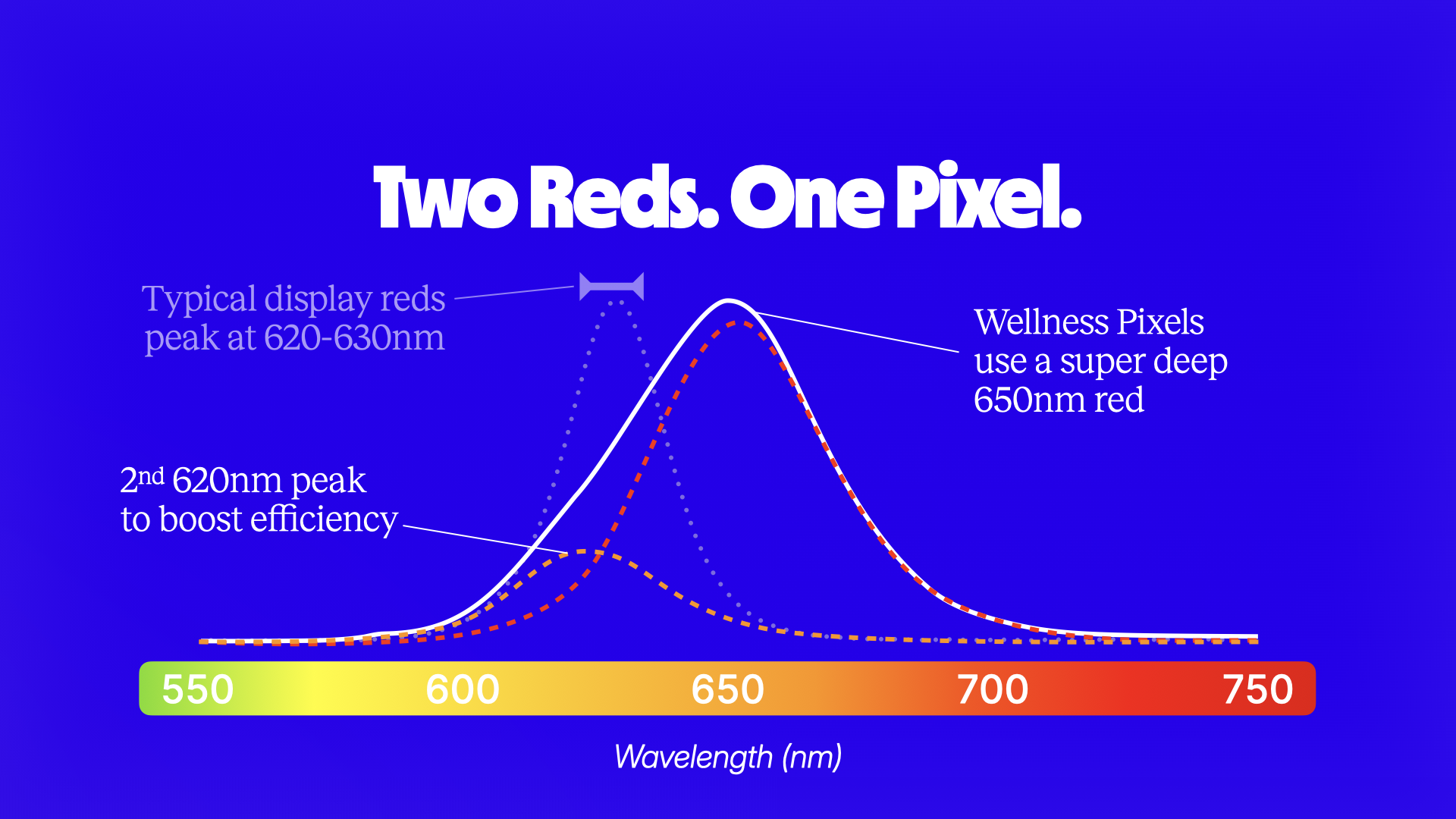
The dual-peak red is where the demo really separates itself. Most displays never push red this deep in the first place, because deep red does not play nicely with human vision. It looks dimmer, it costs power, and it breaks the usual display tradeoffs. Nanosys leaned into that problem instead of avoiding it. The company built a red channel with two roles: a small, efficient 620nm component to keep the image bright, and a true 650nm deep-red peak to anchor the PBM capabilities. The result is not a screen trying to double as a light therapy device, but something closer to a new display category, one that treats wavelength itself as a feature rather than a limitation.
So what is photobiomodulation, and why does deep red matter at all?
Photobiomodulation sounds exotic, but the underlying idea is fairly simple: certain colors of light can interact with cells in meaningful ways. Researchers have spent decades studying how red and near-infrared wavelengths are absorbed by molecules inside cells, particularly those involved in energy production. Mitochondria often get the spotlight here, because they are responsible for generating ATP, the chemical fuel cells run on. The hypothesis is that when these structures absorb the right photons, they can temporarily operate differently, setting off downstream effects in cellular signaling.
Researchers point to a surprisingly wide range of potential benefits of PBM, spanning eye and skin health, inflammation and pain, wound healing, muscle recovery, hair regrowth, and even aspects of brain and mitochondrial function.
The company points to three broad buckets of PBM research that feel most relevant to a display context: eye and visual function, skin appearance, and inflammation. It is easy to see why those are the headline picks. A display illuminates your eyes and face by default. You do not need a new habit. You do not need a new device. You just keep using the screen.
The real story here is not that your next monitor will replace your red light mask. It is that quantum dots turn “color” into “wavelength engineering”. QDs are already famous for making wide color gamut TVs pop. Nanosys is arguing that the next chapter is more intentional: tuning spectra for how we live with displays, not just how we watch movies on them. In its framing, “better pixels” can mean the usual image quality upgrades, plus a spectrum that is designed with humans in mind.
Whether the Wellness Pixel becomes a product category or just a clever CES demo will come down to the unglamorous stuff: measurements, exposure levels, safety standards, and careful claims. But as a piece of tech storytelling, it is hard not to appreciate the pivot. Screens have spent years being cast as a wellness villain. Nanosys is trying to turn one subpixel into a feature, and maybe even a little bit of a redemption arc.
Selected Bibliography
Armitage, H. (2025). Red light therapy: What the science says. Stanford Medicine, Stanford University School of Medicine. February 24, 2025. https://med.stanford.edu/news/insights/2025/02/red-light-therapy-skin-hair-medical-clinics.html
Dompe, C., et al (2020). Photobiomodulation- underlying mechanism and clinical applications. Journal of Clinical Medicine, 9(6), 1724. https://doi.org/10.3390/jcm9061724
Felician, M. C. P., et al (2023). Photobiomodulation: Cellular, molecular, and clinical aspects. Journal of Photochemistry and Photobiology, 17, 100197. https://doi.org/10.1016/j.jpap.2023.100197
Shinhmar, H., et al (2021). Weeklong improved colour contrast sensitivity after single 670 nm exposures associated with enhanced mitochondrial function. Scientific Reports, 11, 22872. https://doi.org/10.1038/s41598-021-02311-1
Wunsch, A., & Matuschka, K. (2014). A controlled trial to determine the efficacy of red and near-infrared light treatment in patient satisfaction, reduction of fine lines, wrinkles, skin roughness, and intradermal collagen density increase. Photomedicine and Laser Surgery, 32(2), 93–100. https://doi.org/10.1089/pho.2013.3616
This article discusses ongoing scientific research into photobiomodulation and wavelength specific light exposure for informational purposes only. The concepts described are not intended to make medical claims, and the prototype display shown is not a medical device and is not intended to diagnose, treat, cure, or prevent any disease.
