
Harvesting sunlight with UbiQD
October 7, 2026
4 min read
Ubiquitous quantum dots for a cleaner, more plentiful world.
Written by Genevieve Michaels
Illustrations by João Marcus Felix
“Originally, oil was photons,” says Hunter McDaniel. Millions of years ago, prehistoric organisms used sunlight to grow, then got buried and pressurized into the oil we pump today.
“All forms of energy are solar, just less efficient,” he continues. “As a kid, I got so excited when I realized that. My dad worked in oil and gas, so I saw how hard and dirty that job was. I remember thinking, if you could convert sunlight directly, why use any other power supply at all?”
That curiosity still drives UbiQD, founded by McDaniel in 2014. Many of UbiQD’s products harvest sunlight, modulating it to better support life on Earth (and maybe, one day, in space).
UbiQD’s quantum dots are built for ubiquity: cadmium-free, they’re less hazardous and cheaper than other solutions. They’re well-suited for sectors like agriculture and clean energy, where they’re deployed across huge surface areas and in objects handled by humans.
Synthesized for ubiquity
McDaniel came to quantum dots by way of electrical engineering, then materials science. He started developing the dots, and prototyping how they could interact with sunlight, during his postdoctoral research at Los Alamos National Laboratory, where he studied with Victor Klimov, the “godfather of quantum dot spectroscopy.”
UbiQD’s quantum dots are ternary semiconductors using copper, indium, and sulfur. Copper and indium replace the hazardous cadmium element. “On the periodic table, copper and indium straddle cadmium, so it makes sense,” says McDaniel. “It's a more exotic semiconductor, because the three elements create more pathways for defects to form.”
As he emerged from his academic career, he saw an opportunity to bring the technology he’d developed from lab to market. “I realized that if I didn’t do this, no one else would,” he says. “I knew this tech better than anyone, and was uniquely positioned to start this company. It felt like a moral obligation; something I owed to myself and others to try.”
Sunlight, red-shifted
A luminescent film designed for greenhouses, UbiQD’s flagship product UbiGro can increase agricultural yield by up to 40%. It uses quantum dots to red-shift the spectrum of sunlight, towards the peak of photosynthetic efficiency. It’s a similar effect to electric grow lights, but without any artificial light at all.
UbiGro can be installed as sheets that hang above plants, or flexible plastic used as a greenhouse roof. It’s even available in smaller “luminescent lanterns” for home gardeners. “Gardeners will send us pictures where around the light, their plants are bigger and bushier,” says McDaniel.
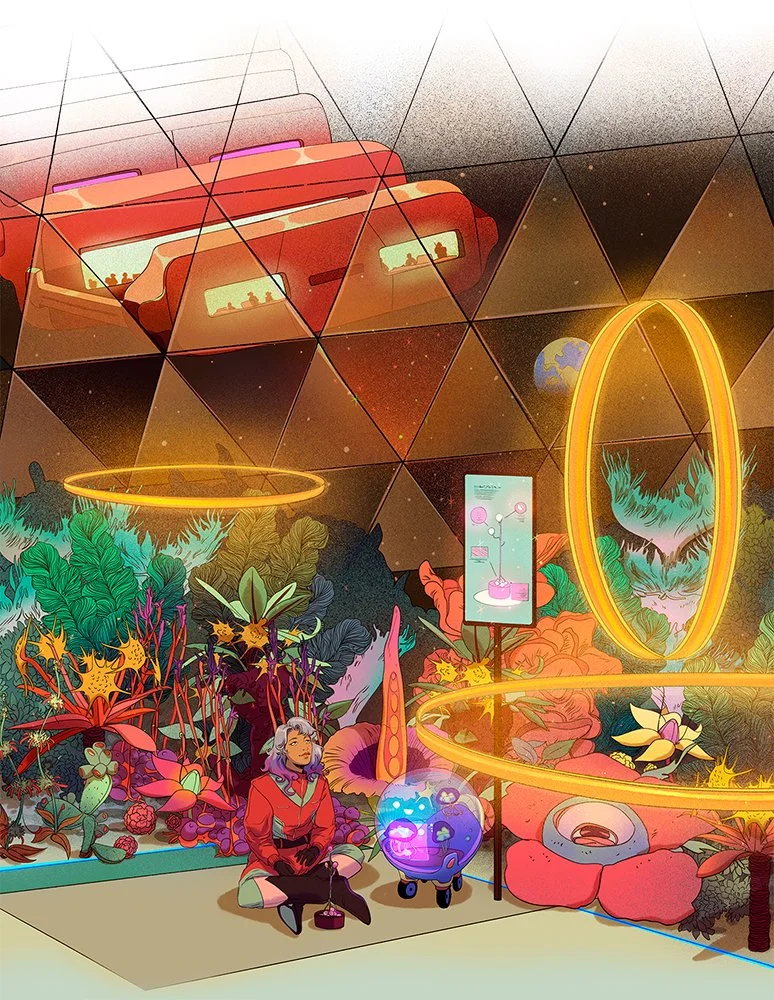
NASA is interested in how the tech could support agriculture in the most extreme conditions possible: outer space. In 2018, they partnered with UbiQD to explore UbiGro for food production on long-term space missions, and potentially even lunar or Mars colonies. “There’s a lot more UV light in space, and our quantum dots are very good at converting it into photosynthetically active light,” McDaniel says.
NASA essentially said they’d get back to us when they’re building their first greenhouse on the Moon. So far, there haven’t been any, but any day now.”
On the Moon, a cold two-week night means greenhouses would need to be buried. UbiGro worked with NASA on a solution for underground greenhouses: bringing sunlight down from the surface using fiber optic cables, then optimizing it underground to grow food.
Quantum dots powering the human race
Despite the space-colony potential, McDaniel is more excited about benefiting life on Earth. Agriculture is truly ubiquitous: there’s an estimated 54 billion square feet of greenhouses on Earth.
“If your greenhouse can produce more per year, that's significant because growers are typically close to the line of profit loss,” says McDaniel. “Food and energy is an area where there's a lot of impact: feeding people, powering the human race.”
The fiber optic solution could also be used for cultivation underneath dense canopies, bringing growth-optimized light down from above the treetops. “NASA looks for products with civilian applications,” says Hunter. “They don’t want to fund tech that’s only useful for space and not Earth.”
Windows to a solar future
On the horizon, UbiQD is exploring how quantum dots could optimize sunlight for solar panels. Just like plants, solar panels convert certain wavelengths more efficiently, so a similar film to UbiGro could be developed for their needs. Quantum dots can also be used as waveguides, absorbing and redirecting photons.
UbiQD combined both technologies in “solar windows:” a pane of glass that redirects sunlight to the edges of the frame, where it’s converted into electricity by tiny solar cells. Between 2016 and 2021, the company received multiple grants from the National Science Foundation to develop and prototype the concept.
Get the latest from Nanosys every Monday at 10:00am.
In 2023, SpaceX brought samples of the solar window into space to see how they’d perform in orbit. “We were the first quantum dots in space,” McDaniel says. “That was probably the largest solar demo project in low Earth orbit. The samples actually went up in a rocket.”
Not all UbiQD’s inventions harness sunlight. The company also makes anti-counterfeit inks and pigments, for applications like passports and currencies. This is another ubiquitous space: the dots need to be affordable enough to print into millions of items, and safe enough for consumers to handle.
I’ve always gravitated towards simpler, less technical use cases.The idea was to be the company that brings the cost down, and brings quantum dots to a massive scale.”
“Myself, and a lot of folks at this company, have been motivated by wanting to have a positive impact,” says McDaniel. The company has kept its operations in the United States, and is now building a facility in its home state of New Mexico. The factory is being built on tribal lands, benefiting the state’s Indigenous nation.
“There’s way more energy on Earth that we need. If we’re smart about it, we can use that energy more effectively to not just survive, but thrive. That’s why we’re so motivated to use Quantum Dots to optimize how we harvest sunlight.”

Gain clarity on Quantum Dot technology.
Excited about Quantum Dots but unsure to apply them to your tangible product? Our team answers your big questions about this tiny technology.